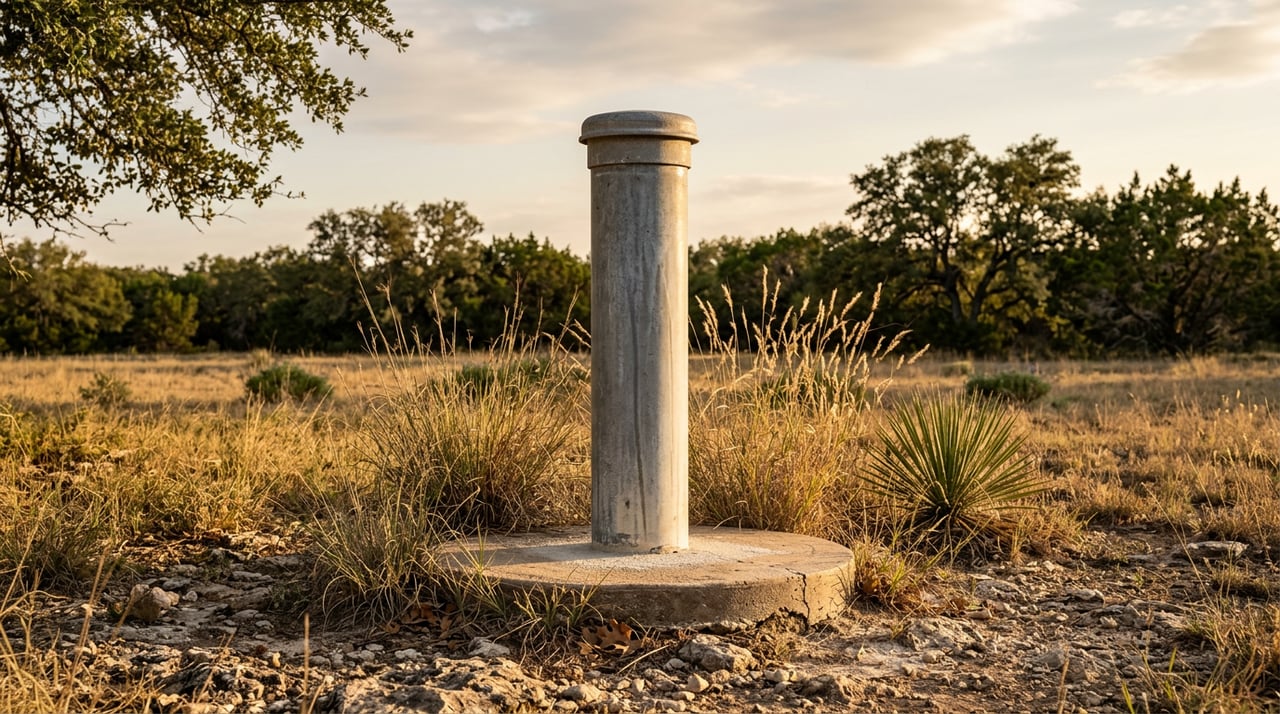
Lampasas County's Well Rules Keep Changing. Here's What That Means If You're Buying Acreage.
September 17, 2026
September 17, 2026
Picture two tracts sharing a fence line in Lampasas County. Same soil, same aquifer, same rainfall. One is nine acres. The other is eleven. Under the rule Lampasas County's groundwater district has enforced since November 2024, the well on the smaller tract needs a permit and the well on the larger one doesn't. That line isn't drawn by geology. It's drawn by a five-member elected board, and that board changed where it sits again last month.
Most buyers assume Texas water law is a fixed thing you can look up once and trust. It isn't. The rule that decides whether a rural well requires a permit, a fee, or nothing at all is set locally, by district boards with limited budgets and real pressure on them, and in Lampasas County it has moved twice in under two years. What you read about well rules six months ago, or even found on a state guide last week, may already be behind what's actually on the books.
In late August, the Saratoga Underground Water Conservation District's board voted to eliminate permit and annual renewal fees for domestic-use and livestock wells on tracts of ten acres or less. Board President Paul Cline and Director Stan Wilson led that discussion, and the change came out of a larger package of rule revisions presented by Ardurra Group, the outside firm the district contracts with to manage its day-to-day operations.
The paperwork didn't disappear. A well on a smaller tract still has to be registered with the district. What changed is the ongoing cost of keeping it in good standing. Before this vote, a landowner on a nine-acre parcel using a well for a house and some livestock was paying into the same fee structure built for larger commercial operations.
That August vote followed a bigger shift the district made in November 2024, when it redefined what counts as an exempt well in the first place. New wells developed after November 14 of that year are exempt if the tract is larger than ten acres, and classified as non-exempt if the tract is ten acres or less. For anyone comparing two parcels on either side of that line, the practical difference used to be real money: a $250 well registration fee, an $800 operating permit application fee for higher-production wells, an $800 transport permit fee for any water intended to leave the county, and a 50 percent surcharge on groundwater exported outside Lampasas County, on top of per-acre-foot production fees.
A buyer who found an old summary of Lampasas County well rules, even one written accurately at the time, would have been reading about a threshold and a fee schedule that no longer fully apply.
The ten-acre line itself isn't a geological fact about the aquifer. It's a policy choice five people can revisit at a quarterly meeting, and in this district, they have.
Saratoga UWCD was created by the Texas Legislature in 1989 as Lampasas County's sole groundwater authority, and it has no taxing power. Its entire budget depends on what the county commissioners choose to appropriate. As of this summer, that appropriation was $12,500 a year, and district leadership has been telling commissioners that isn't enough to keep up with the county's growth or to properly study its own aquifer levels. By late August, commissioners were weighing a $37,500 increase, and that funding question was explicitly tied to how the district classifies exempt wells.
A district running on a shoestring budget, trying to convince its county to fund better aquifer monitoring, is going to keep adjusting the rules that determine who pays into that budget and how much. That isn't a criticism of the board. It's the mechanism. If you're evaluating a tract today, the honest due diligence question isn't just "what's the current rule," it's "how likely is this rule to move again before I close."
Cross into Burnet County and the entire framework changes. The Central Texas Groundwater Conservation District, created by the Legislature in 2005, requires registration of every well in the county and permits for non-exempt production, with boundaries that match Burnet County exactly. This January, the district adopted new rules creating the Northeast Burnet County Trinity Aquifer Management Zone, a designation that came out of what the district describes as a deliberate, well-documented public process. As of this summer, the district was also actively working through a groundwater permit application tied to a proposed quarry west of Burnet on FM 3509.
Burnet's district has also built out enforcement in ways Lampasas hasn't matched. It requires 50 feet of annular cement around a well casing, five times the state's 10-foot minimum, and it has been tagging wells with QR codes linked to district records so owners and future buyers can pull up depth, water level, and drilling date without digging through old paperwork.
Head into Williamson County and the picture flips again. There is no groundwater conservation district there at all. The county sits surrounded by six of them, Clearwater to the north in Bell County, Post Oak Savannah to the east, Central Texas GCD to the west in Burnet County, Lost Pines to the south, Hays Trinity and Blanco-Pedernales further southwest, but none of that coverage extends into Williamson itself.
In February 2024, a group called the Aquifer Conservation Alliance petitioned to bring the western half of Williamson County into the Clearwater Underground Water Conservation District. Clearwater's board voted the petition down, citing the cost of running the required confirmation election, roughly $75,000 in Bell County and another $380,000 in Williamson County. By 2021, an estimated 1,775 wells were already registered in just the western part of the county, with no local authority tracking drawdown or capping production.
That started to shift last November, when Williamson County commissioners committed $500,000 in the fiscal year 2025-26 budget toward a regional water-supply study, with engineering proposals due in February 2026 and a recommendation expected to reach commissioners by March. As of this writing, that study is underway, but Williamson County still has no permitting authority of its own. If you're drilling there today, the rule of capture applies with no local modification at all.
The acreage on the listing sheet isn't the whole story. Here's what actually matters before you close:
Does the November 2024 change affect wells that were already drilled? The rule applies to new wells developed after November 14, 2024. A well drilled before that date should be classified according to whatever rule was in effect when it went into the ground, which is exactly why the paperwork's date matters more than a verbal summary of "the current rule."
Is this a Lampasas-only situation? No. Roughly 100 of Texas's 254 counties have their own groundwater conservation district, and each one writes and revises its own rules independently. That's how Lampasas County, Burnet County, and Williamson County can have three entirely different regulatory realities within a short drive of each other, all drawing from the same broader Hill Country aquifer system.
If I already own acreage with a well, does any of this matter to me? It matters most when you go to sell. Buyers are increasingly asking for well registration and permit documentation before closing. Being able to hand over paperwork that shows which rule applied when the well was drilled, along with confirmation of its current standing with the district, removes a friction point that can otherwise slow down a transaction.
Water rules on Hill Country acreage aren't something you check once and file away. They're closer to a moving target set by boards with real budget constraints and real reasons to keep adjusting the lines. If you're evaluating a specific tract in Lampasas, Burnet, or Williamson County and want to understand exactly which rules apply to it right now, Jim Banks has spent two decades in this country and knows where to look before you're under contract. Let's Connect.
Stay up to date on the latest real estate trends.
Ready to buy or sell in the Texas Hill Country? Connect with Jim Banks for expert guidance, strategic marketing, and results-driven representation tailored to your ranch or luxury property.