Burnet County Land Due Diligence Tips Before You Buy
July 2, 2026
July 2, 2026
If you are buying land in Burnet County, it is easy to focus on the views, the trees, or the promise of future plans. But a beautiful tract can come with real surprises if you do not verify access, title, utilities, flood exposure, and development limits before closing. This guide walks you through the due diligence steps that matter most in Burnet County so you can move forward with more clarity and fewer costly surprises. Let’s dive in.
Before you think about building, fencing, or financing, make sure you know exactly what property is being conveyed. In Burnet County, public records maintained by the County Clerk include deeds, maps, plats, and other records that help confirm a tract’s size, shape, location, legal description, and ownership.
This step sounds basic, but it protects you from bigger problems later. A listing summary or tax record alone is not enough to confirm that the tract on paper matches the land you believe you are buying.
One of the most important land-buyer checks is making sure your title commitment, survey, and earnest money contract all line up. The Texas Department of Insurance says buyers should compare the legal description in the title policy against the survey and the contract before closing.
This review can uncover issues that are especially important with rural land. Possible defects can include unrecorded easements, no right of access, and undisclosed restrictive covenants.
Burnet Central Appraisal District offers a property search and interactive map that can help you verify parcel details. It appraises real and business personal property in Burnet County under Texas property tax rules, which makes it a useful second layer for checking parcel ID, map location, and ownership information.
That does not replace title work, but it gives you another way to confirm that the tract being marketed matches the tract in the public record. For larger acreage and irregular parcels, that extra check can be very helpful.
Title insurance is not mandatory in Texas, but it still plays an important role. The Texas Department of Insurance notes that lenders usually require a loan policy, and title companies review public records such as deeds, liens, court judgments, encumbrances, and maps to identify potential issues.
For a land buyer, the title commitment is where many of the practical red flags first show up. It is also worth knowing that title insurance rates are regulated in Texas, while escrow and closing fees can vary by agent.
A gate, ranch road, or visible driveway does not automatically mean a tract has legal access. For Burnet County land buyers, this is one of the most important early questions because a title defect can include no right of access to and from the land.
You want to confirm recorded access easements, public road frontage, and any private road maintenance arrangement before contingencies are waived. This matters even more with flag lots, shared drives, or older rural deeds where the route on the ground may not tell the full legal story.
If you plan to improve the property later, Burnet County’s addressing process matters. The county states that it does not assign 9-1-1 addresses to vacant lots or undeveloped property. Addresses are assigned to structures or development projects.
The county also states that all new addresses off a county road or TxDOT road must receive driveway approval before an address will be assigned. The application requires the property ID from Burnet CAD and a map image showing lot lines and proposed access.
That means the real question is not just, “Can I get onto the property?” It is also, “Is there a workable access point that meets county requirements if I build later?”
If you are considering a tract because you may split it, cluster it, or develop it as a subdivision, that needs careful review. Burnet County recommends a site review with the latest survey and a registered professional land surveyor familiar with state and local platting laws.
The county also notes that subdivision regulations are available through the County Clerk’s office. If future division is part of your plan, this is not something to leave to assumption.
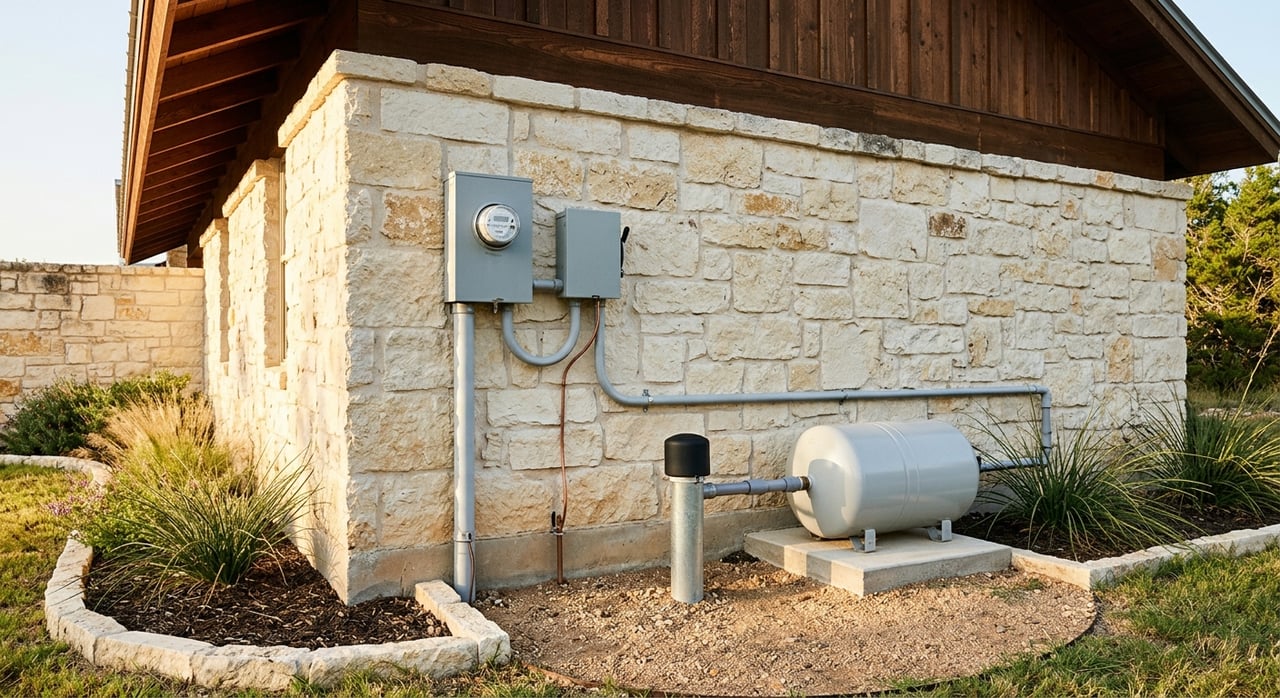
Utility due diligence is where many land purchases become more complex. A listing may suggest that a tract is buildable, but in Burnet County, septic, well, and utility questions each need separate verification.
The most practical questions are straightforward: Can the property support septic? Will it need a private well? Are utilities already installed, permitted, or only theoretically possible?
Burnet County requires building and septic permits, and septic permitting is a key step for many rural tracts. The county states that the licensed installer usually submits the septic application along with the site evaluation, system design, and any required maintenance documents.
Just as important, the site evaluation determines what type of septic system can be installed. The Texas Commission on Environmental Quality also states that on-site sewage facilities must be designed from a site evaluation that accounts for local conditions, and almost all systems need a permit before construction, installation, repair, extension, or alteration.
Burnet County’s subdivision regulations go even further by stating that the county will permit and inspect all on-site systems regardless of tract size. In short, never assume a tract will support the septic setup you want until that evaluation is done.
If a tract depends on a private well, treat that as something to verify, not something to assume. The Central Texas Groundwater Conservation District states that all wells must be registered, and certain wells must receive authorization before drilling.
If a well already exists, ask for the well report, pump history, and recent water testing if available. The Texas Water Development Board states that its water well report viewer can help locate well reports, and it also notes that private well water quality is not regulated by the state, which means the owner is responsible for water quality problems.
One of the easiest mistakes in land buying is confusing possible utility service with actual utility service. A tract may have nearby infrastructure without having approved, installed, or functioning service on the parcel itself.
That is why your due diligence should focus on what is present today, what has already been permitted, and what would still need approval. In Burnet County, that distinction can shape both your timeline and your budget.
Burnet County includes hills, valleys, lakes, and river corridors, and the county notes that flood zones primarily follow the Colorado River and local creeks. If the tract is near creek frontage, river bottoms, low ground, or lake-adjacent areas, flood review should happen early.
This is not just a box to check for insurance. It can affect where and how you build, what permits are required, and whether added documentation is needed before construction begins.
Burnet County Development Services provides flood-zone determinations, FIRMs, flood insurance requirements, and elevation certificate information. The county also states that development in a designated flood-hazard boundary area requires a permit, a site plan, and a pre-construction elevation certificate.
The county further notes that basic homeowners insurance does not cover flood damage. For that reason, floodplain review is a land issue as much as it is a future structure issue.
Even if only part of a tract is affected by floodplain, that can still matter. You need to know whether the usable homesite, access route, creek crossing, or utility path is impacted.
That is especially true on larger parcels where the tax parcel itself may look fine at a glance, but the most practical building area sits near lower ground. A tract can be attractive and still require thoughtful planning.
Raw land often requires more coordination than a standard home purchase. Financing can also be more specialized, especially when the property has non-standard features or appraisal challenges.
For Burnet County land buyers, the most effective approach is usually a practical team that fits the property. Depending on the tract, that may include a rural-experienced lender, title company, surveyor, septic professional, well professional, and Burnet County Development Services.
Land financing is not always as straightforward as home financing. If the tract has unique acreage, utility questions, or development unknowns, those details can affect loan options and timelines.
That is why it helps to talk with a lender experienced in rural property early in the process. Clear expectations on the front end can save time once inspections, surveys, and title review are underway.
Strong land due diligence is not about adding unnecessary complexity. It is about making sure each question is answered by the right source before you close.
Your title company can help identify recorded issues. Your surveyor can confirm boundaries and access on the ground. County Development Services can clarify local permitting and floodplain requirements. Together, those answers help you make a more confident decision.
In Burnet County, good land buying is not just about finding the right acreage. It is about confirming what that acreage can legally and physically support based on title, access, septic, wells, floodplain, and future plans.
When you slow down and verify those details up front, you put yourself in a far better position to protect your investment and avoid expensive surprises later. If you want experienced guidance as you evaluate ranch land, waterfront property, or development tracts in the Hill Country, connect with Shipley Ranches for a practical, locally informed approach.
Stay up to date on the latest real estate trends.





Ready to buy or sell in the Texas Hill Country? Connect with Jim Banks for expert guidance, strategic marketing, and results-driven representation tailored to your ranch or luxury property.