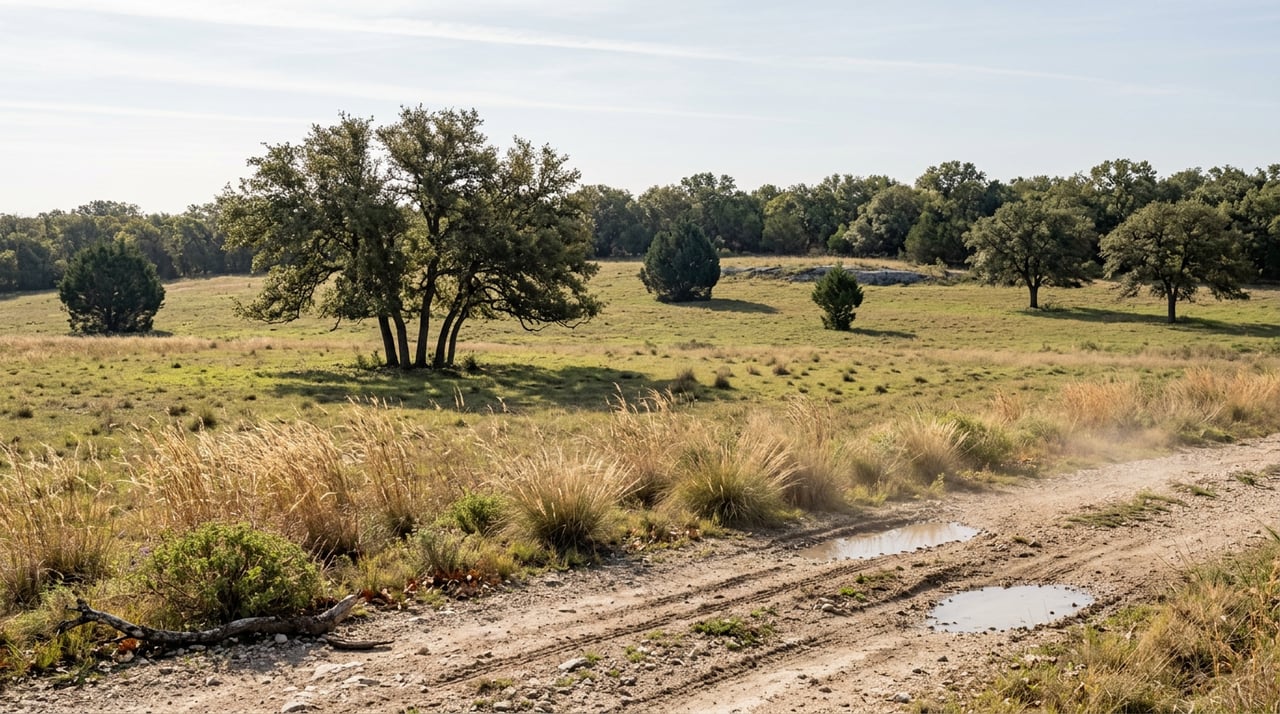
Texas Hill Country Land Prices Per Acre by Tract Size
August 27, 2026
August 27, 2026
Picture two tracts closing in the same Hill Country county in the same month. One is a small parcel with a good building spot and road frontage. The other is a few hundred acres of working pasture a couple of ridgelines over. Both could plausibly close near the regional average everyone has been quoting all year. Only one of those closings tells you what land like it actually costs, and it isn't the one that matches the headline number.
That gap between a small tract's price per acre and a large tract's price per acre is not a rounding error. It is the single biggest reason buyers and sellers in the Texas Hill Country keep talking past each other in 2026, and almost nobody explains it before a client walks into a negotiation with the wrong number in their head.
The number making the rounds this year comes from the Texas Real Estate Research Center at Texas A&M, which tracks the Austin-Waco-Hill Country region as its own market (TRERC calls it Region 7). For 2025, that region closed the year at a record $7,911 per acre, up 8.15 percent year over year, with sales volume climbing more than 10 percent. It is a real number, verified from actual transactions, and it is genuinely the strongest close TRERC has recorded for the region.
What most people miss is that TRERC's headline regional price is built almost entirely from large-tract sales. The Center defines a size cutoff by region, and everything above that line feeds the number everyone repeats. Everything below it gets tracked separately, in a dataset most buyers never see.
That separate small-tract dataset tells a different story. For the fourth quarter of 2025, Hill Country small tracts, the ones under the regional size threshold, sold at a median of $17,529 per acre, up 7.7 percent year over year. That is more than double the large-tract figure, recorded in the same region during the same stretch of the year.
This isn't a mistake in either number. Small parcels have always traded at a premium per acre because they draw a much wider pool of buyers: families shopping for a homesite, weekend recreational users, investors who want flexibility, landowners rounding out an adjoining fence line. A wider buyer pool bids up the per-acre price on every parcel, even as the total dollar figure for a 15-acre tract stays far smaller than a 300-acre one. Large acreage serves a narrower set of working ranchers, hunters buying scale, and long-horizon land investors, so competition per acre is thinner even when total demand is strong.
When sales slow, the tracts that still close aren't a random sample of the market. They tend to be the best located, best watered, best improved properties available. A median built from that smaller, higher-quality slice can rise even if no individual property gained value over the prior year.
TRERC's own quarterly commentary calls this the composition effect, and it shows up across the state, not just in the Hill Country. But it matters more here than almost anywhere else in Texas, because the region's mix of homesite buyers and ranch buyers is unusually wide.
| Segment | Time window | Median price per acre | Year-over-year change |
|---|---|---|---|
| Large tracts, Austin-Waco-Hill Country (Region 7) | Q4 2025 | $7,911 | +8.15% |
| Small tracts, Austin-Waco-Hill Country (Region 7) | Q4 2025 | $17,529 | +7.7% |
| Statewide, all tract sizes | Q2 2026 | $5,218 | +3.27% |
The statewide line is there for scale. It shows the Hill Country trading at a real premium to Texas overall, on either measure, which lines up with what buyers already sense when they compare a Hill Country listing to something in the Panhandle. What the table also shows is that asking a broker "what's land going for per acre" without specifying tract size is close to asking what a house costs without saying how many bedrooms.
By the second quarter of 2026, the statewide price had plateaued at $5,218 per acre, essentially flat against the prior quarter, with five-year annualized growth moderating to 8.17 percent from the double-digit pace of prior years. Statewide total acres sold fell 12.57 percent and total dollar volume contracted roughly 9.7 percent year over year even as the median price held steady, a pattern TRERC attributes largely to the same structural shift toward smaller, pricier-per-acre parcels rather than to a change in buyer appetite.
There's a second layer to this that matters just as much as tract size. TRERC's second-quarter 2026 report describes a persistent standoff between buyers and sellers: sellers anchored to peak 2022-23 valuations holding firm on price, buyers cautious after years of steep appreciation and still-elevated interest rates. Neither side is behaving irrationally. Sellers remember what comparable land fetched two or three years ago. Buyers remember what borrowing costs have done since.
The practical effect is that well-located, well-improved land with water, fencing, and access still moves quickly and holds its price. Everything else sits. TRERC's own language from an earlier report put it plainly: good, well-located properties with superior features continue to garner strong interest and sell quickly, but if the listing price is too high, the phone might not ring. That is as true for a 15-acre homesite outside Marble Falls as it is for a 400-acre working ranch near Llano.
If you're shopping 10 to 40 acres for a homesite or weekend retreat, price your expectations closer to the small-tract figure, not the regional headline. You are competing against families, recreational buyers, and investors, all bidding for the same scarce category of usable, accessible acreage.
If you're shopping 200 acres or more for a working ranch or legacy property, the large-tract number is your realistic benchmark, and the 2026 plateau in statewide activity gives serious buyers more room to negotiate than the headline percentage gains suggest.
Water changes both categories. Land with a spring-fed creek, river frontage, or reliable well access in counties like Burnet, Blanco, Llano, or Gillespie routinely commands more than dry pasture nearby, in both the small-tract and large-tract markets. Verifying the water situation before you fall for a view is not optional due diligence, it's the difference between the two prices in the table above.
Sellers anchored to 2022-23 pricing are still out there. If a listing looks priced for a market that peaked two years ago, expect a longer runway to close, not a quick no. TRERC's data shows exactly this kind of inventory sitting longer, even while headline prices climb.
Is Hill Country land in a bubble that's about to correct? TRERC's own forecast calls for only small price increases in the near term, with a slight decline in acres sold and a steady recovery in sales volume not expected soon. That's a market cooling off, not one showing the volume collapse that preceded prior busts in the mid-to-late 1980s or 2009-11. A significant statewide retracement is considered unlikely under the Center's baseline model.
Why did total acres sold drop in 2026 even though prices held steady? Largely the same composition effect driving the small-tract and large-tract gap. When the mix of what's selling shifts toward smaller parcels, total acreage transacted falls even while the median price per acre looks stable or rising, because fewer big tracts are changing hands.
Does a rising regional median mean my specific tract of interest is worth more this year? Not automatically. The median reflects what's actually closing, which right now skews toward higher-quality, better-located parcels. A tract without water, road frontage, or a usable building site can sit at a discount to that median for months, regardless of what the regional headline says.
Land math in this part of Texas rewards buyers and sellers who ask which market they're actually in before they anchor to a number. If you're weighing a homesite against a working ranch, or trying to price a family property honestly against 2026 conditions, Jim Banks has spent two decades reading Hill Country land the way it actually trades, not the way a single average makes it look. Let's Connect.
Stay up to date on the latest real estate trends.
Ready to buy or sell in the Texas Hill Country? Connect with Jim Banks for expert guidance, strategic marketing, and results-driven representation tailored to your ranch or luxury property.