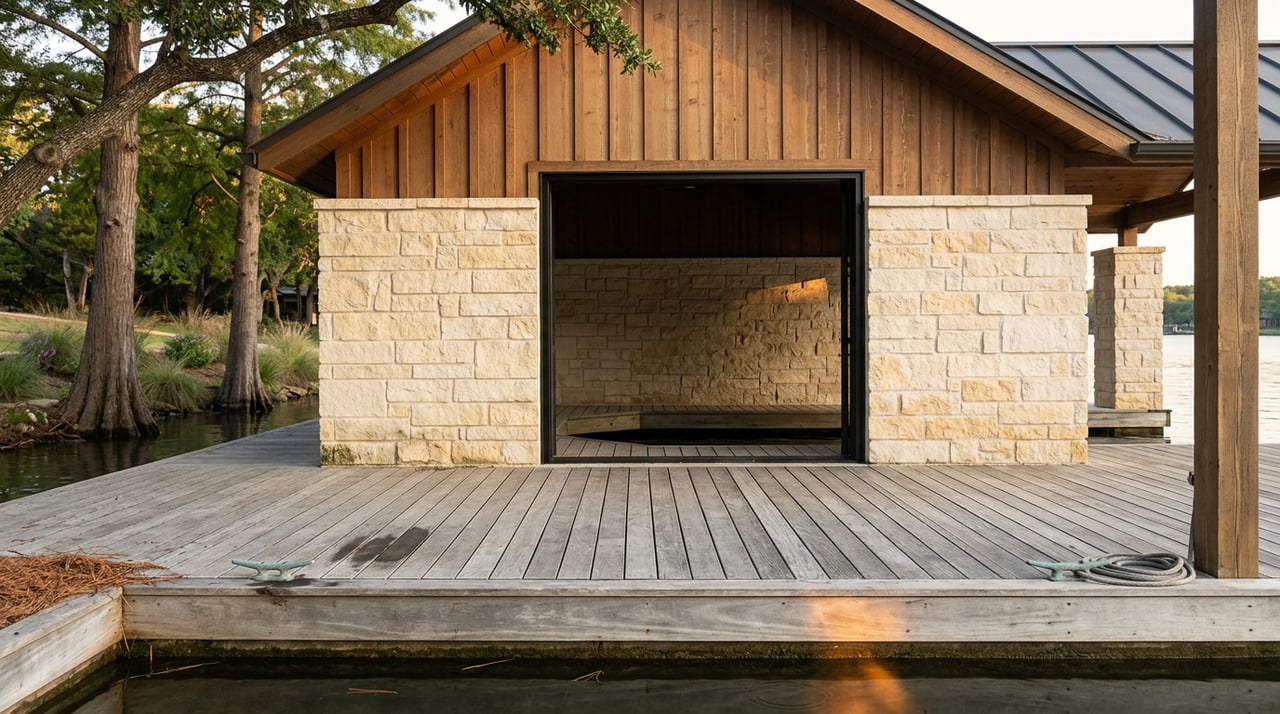
Every Highland Lake Looks Full Right Now. Some Are Built to Stay That Way
August 13, 2026
August 13, 2026
Stand on a dock at Horseshoe Bay this month and the water reaches right up to the boards. Drive forty minutes south to a cove on Lake Travis and you will see the same thing: full pool, floating docks, boats tied off at the same waterline they occupied last summer. As of early August 2026, Lake Travis sits at 99.2 percent of capacity and Lake Buchanan at 99.1 percent. Every one of the six Highland Lakes looks, from a listing photo, like the same product.
It is not.
Two of those lakes, Buchanan and Travis, are water-supply reservoirs that the Lower Colorado River Authority built to rise and fall on purpose, capturing rain when it comes and releasing water downstream when it does not. The other four, Inks, Lake LBJ, Lake Marble Falls, and Lake Austin, are pass-through lakes that LCRA holds within roughly a one-foot range using the dams above and below them. That distinction, not the view from the dock this week, is what determines whether a waterfront purchase on the Hill Country's lake chain is a stable long-term asset or a bet on rainfall.
Right now that difference is invisible. A buyer touring Lake LBJ and a buyer touring Lake Travis this month sees identical water. But rewind to mid-2025 and the two lakes told very different stories. Combined storage in Buchanan and Travis had fallen to about 51 percent of capacity, and LCRA's own reporting describes the lakes at that point as behaving exactly as designed, rising in wet years and dropping in dry ones. Meanwhile LBJ, Marble Falls, Inks, and Austin held their normal levels, because that is what a pass-through lake is built to do regardless of drought.
Then came the July 2025 floods. LCRA recorded combined storage in Buchanan and Travis jumping from 51 percent to more than 90 percent within days. It did not stay there on a straight line. By March 1, 2026, combined storage had settled to about 84 percent, or roughly 1.68 million acre-feet. By early June 2026, Travis alone was still hovering around 83 percent. Then more rain pushed it the rest of the way, and by August 9, 2026, Travis was reading 99.2 percent full. That is not a lake holding steady. That is a lake doing exactly what a reservoir does, tracking rainfall up and down over a period of months, because tracking rainfall is its job.
The reason this distinction matters to a buyer is not abstract. During the 2011 to 2015 Texas drought, one of the most severe in the state's history, Lake Travis fell below 620 feet above mean sea level in the fall of 2011, more than 60 feet under its full pool elevation of 681 feet. Docks across the lake sat on dry ground. Boat ramps closed. That kind of drop does not happen on Lake LBJ or Lake Marble Falls, because those lakes are not allowed to fall that far. They are managed specifically so it cannot.
It also does not reverse overnight when the rain comes back. Waterfront values on reservoir lakes tend to lag the water by years, not weeks, because buyer confidence takes longer to rebuild than the lake does to refill. A property that loses its dock for three drought summers carries that memory into its next sale, even after the water returns.
In a 2025 LCRA news release explaining the reservoirs' drought behavior, the authority's executive vice president of water, John Hofmann, put it plainly:
"The lakes are doing exactly what they're supposed to do. They are still stressed from years of drought."
That is the sentence a waterfront buyer should hold onto. A reservoir lake being low is not a malfunction. It is the design working as intended, which is exactly why it can happen again.
None of this means the four pass-through lakes never move. LCRA lowers one of them on a rotating basis for maintenance, most recently Inks Lake, which dropped about 8 feet over eight weeks starting October 1, 2025, the first drawdown there since 2020. The purpose was practical: give shoreline owners a window to repair docks, retaining walls, and boat slips, and to dredge accumulated silt, before refilling the lake by late November. LCRA does not decide which lake gets a drawdown, or whether one happens at all, until each fall, based on conditions at the time.
The difference between that kind of change and a drought on Travis is the difference between a scheduled outage and a blackout. One is announced months ahead, lasts a known number of weeks, and gives every owner on the lake the same maintenance window. The other has no end date and no guarantee it corrects itself before you need to sell.
Here is how the six lakes actually sort:
| Lake | LCRA classification | Normal behavior |
|---|---|---|
| Buchanan | Water-supply reservoir | Fluctuates with rainfall and drought; year-round target of 1,020 ft since January 2025 |
| Travis | Water-supply reservoir | Fluctuates; normal operating range roughly 670 to 681 ft, full pool 681 ft |
| LBJ | Pass-through, constant level | Held within about a foot under normal conditions |
| Marble Falls | Pass-through, constant level | Held within about a foot |
| Inks | Pass-through, constant level | Held within about a foot, except scheduled maintenance drawdowns |
| Austin | Pass-through, constant level | Held within about a foot |
None of the four categories is inherently the wrong choice. Reservoir lakes carry more shoreline and, at moments like this one, more dramatic recovery upside. Pass-through lakes carry more certainty and, during a maintenance drawdown, more short-term inconvenience. The purchase decision comes down to a handful of concrete questions a buyer can ask before writing an offer.
No. The mechanism has not changed, only the current rainfall total. LCRA's water management plan still ties future releases and restrictions to combined storage thresholds, and the same lakes that filled quickly in 2025 and 2026 can decline just as steadily if the rain stops.
Lake LBJ, Lake Marble Falls, Lake Austin, and Inks Lake are managed as pass-through lakes and held within roughly a one-foot operating range under normal conditions. Buchanan and Travis are the two reservoir lakes designed to fluctuate.
Not typically. Buyers and appraisers generally treat it as routine maintenance with a fixed calendar, unlike a drought with no set end date. The real risk is timing your own dock repairs around it, since the windows are announced only months in advance and fill quickly once they are.
Waterfront property in the Hill Country rewards buyers who ask what a lake is built to do, not just what it looks like on the day of the showing. If you are weighing a listing on Travis against one on LBJ, or trying to read what a current lake level actually means for a specific dock, Jim Banks has spent two decades in this country learning where the water goes when the rain stops. Let's Connect to talk through the specific lake, cove, and dock before you write an offer.
Stay up to date on the latest real estate trends.





Ready to buy or sell in the Texas Hill Country? Connect with Jim Banks for expert guidance, strategic marketing, and results-driven representation tailored to your ranch or luxury property.