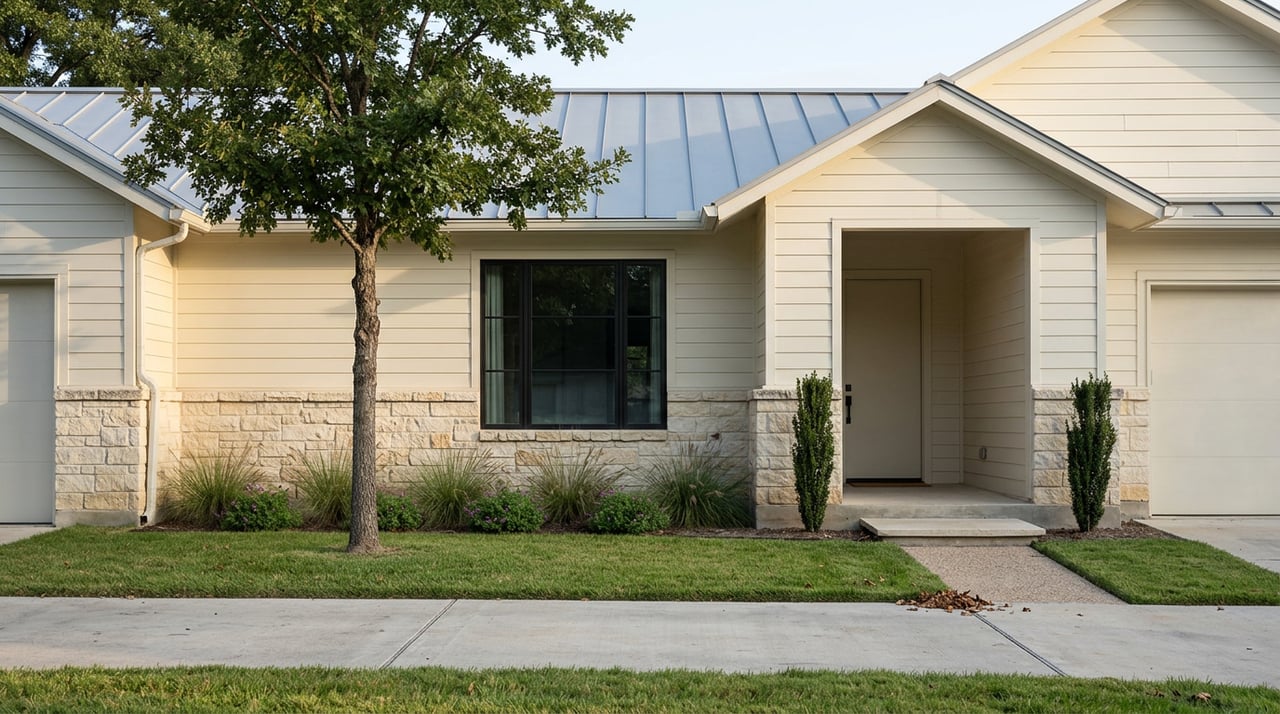
The Samsung Gap: Why Home Prices Near Taylor Haven't Caught Up to the Story Yet
August 20, 2026
August 20, 2026
If a $17 billion semiconductor plant is being built forty minutes from your front door, shouldn't your home be worth more because of it?
That's the assumption baked into almost every piece of Central Texas real estate marketing built around Samsung's Taylor campus since 2021. The plant is real, the jobs are real, and the money behind it keeps growing. But if you pull the actual price data for Taylor, Texas right now, in August 2026, it tells a different story than the one being sold. Homes near the plant are worth less than they were a year ago, not more. Understanding why is the difference between buying ahead of a real shift and buying into a narrative that hasn't landed yet.
Taylor's median sale price sat at $275,000 in January 2026, down 14.4 percent from the year before, with homes taking an average of 110 days to sell compared to 100 days the prior January. By June, the average home value in Taylor had fallen 5.1 percent year over year. Move forward to July 2026 and the median list price was still declining on a year-over-year basis, with price per square foot down roughly 8 to 9 percent and homes sitting on the market for a median of 135 days.
Three different measurement windows across seven months, three different data trackers, and they all point the same direction. That consistency matters more than any single number. If this were noise from one thin data set, you'd expect the readings to disagree. They don't. Taylor's housing market has been softening through the exact period when Samsung's Taylor site has gone from under-construction rumor to a campus with employees actually walking through the door.
That's the gap worth understanding before you decide whether Taylor, Hutto, or a more established Williamson County city fits your plan.
Here's the piece that explains a lot of the confusion. Samsung announced the Taylor project in November 2021 and broke ground in the first half of 2022. That announcement did move real estate, but it moved land and speculative parcels near the footprint, not the broad base of single-family resale homes across the eastern county. Taylor Independent School District approved a series of Chapter 313 style tax agreements with Samsung in December 2022, which is the kind of local economic development deal that signals a city planning around a large employer for the long term, not a fast flip.
That first wave of enthusiasm happened three to four years ago. It's largely done its work. What's happening in 2026 is a second, separate question: has the employment side of the project actually shown up in a way that supports higher home prices today? The data says not yet, and the reason has to do with how the workforce is arriving.
Samsung's Taylor site sits on 1,200 acres at the edge of the city. Employee transitions began in November 2025, when several hundred workers, many coming from Samsung's existing Austin campus, started moving into a newly completed six-story office building at the center of the site. The Taylor Economic Development Corporation said in a public update that roughly 1,000 employees would move into that office building over two quarters. Samsung's own communications team has put the target at about 1,500 permanent employees on-site by the end of 2026, with a longer-run buildout toward 1,800.
That's a meaningful number of new households, but it is arriving in stages spread across more than a year, not as a single hiring event. A homebuyer scanning headlines from 2021 sees "$17 billion plant, thousands of jobs" and assumes the housing effect happened already. The actual hiring math says the durable demand from this workforce is still in its early rounds, which is a very different situation for anyone deciding whether to buy in Taylor now expecting appreciation to follow quickly.
The other half of the mismatch is timing. Samsung originally targeted a second half of 2024 opening for the Taylor fab. That slipped to 2025, then to an end of 2026 target as of spring 2026. As of June 2026, Samsung's own foundry leadership told industry press that the site is now aiming for early 2027, tied to a decision to skip an intermediate chip generation and move straight to a more advanced 2-nanometer process.
At the same time, the broader Samsung story in Texas has kept expanding rather than pulling back. The company confirmed in 2026 that it is relocating its consumer electronics headquarters from New Jersey to Plano, consolidating its US leadership closer to its Austin and Taylor manufacturing operations. Samsung also locked in a multi-year, roughly $16.5 billion contract to manufacture Tesla's next generation AI chips at the Taylor facility, a deal that gives the plant a committed customer once it does come online. Total investment commitments tied to the site have grown from the original $17 billion figure toward numbers in the $37 billion range as the project has expanded.
So the corporate story is getting bigger while the manufacturing timeline keeps sliding to the right. That combination, more investment stacked on top of a later start date, is exactly the kind of thing that keeps a housing market treading water. The eventual demand is more credible than ever. The date it shows up in resale comps keeps moving.
The Williamson Central Appraisal District mailed its 2026 property appraisal notices at the end of March, and the countywide numbers confirm this isn't a Taylor-only story. Average market value across Williamson County fell from $473,876 in 2025 to $455,812 in 2026, a decline of about 3.8 percent, with the county's Deputy Chief Appraiser describing it as continued market stabilization rather than a sharp correction.
| City | 2026 average value | Change from 2025 |
|---|---|---|
| Hutto | $338,519 | down 6.08% |
| Williamson County (all) | $455,812 | down 3.8% |
| Leander | $465,503 | down 2.85% |
Hutto, which sits along the same TX-79 and I-35 corridor as Taylor and gets swept into the same Samsung-adjacent marketing, posted the county's steepest decline. Leander, further from the plant and more built out as an established suburb, posted the smallest one. That spread is the clearest local evidence that proximity to the Samsung site hasn't been protecting home values this cycle. If anything, the cities closest to the project are softening the most, likely because so much new and speculative inventory was built there in anticipation of demand that is still ramping.
Move west toward the county's more established cities and the tone of the market changes. Active listings in Georgetown were up roughly 5.5 percent year over year in early 2026, and homes there were still selling close to asking price, with sale-to-list ratios reported in the mid-90s to high-90s percent range depending on the month. Closed sales tracked over the six months ending August 2026 put Georgetown's median closing price near $489,900, well above Taylor's and Hutto's numbers and far less tied to a single employer's timeline.
Round Rock, the county's largest and longest-established city, doesn't carry the same speculative weight at all. It has decades of built-out neighborhoods, diversified employers, and a housing stock that isn't leaning on one factory's opening date to justify its pricing. That's not a claim that Round Rock or Georgetown are better investments. It's a claim that they're answering a different question. Taylor and Hutto are pricing in a future. Georgetown and Round Rock are pricing in a present that already exists.
If you're weighing where to buy across this county, the Samsung headline shouldn't be the deciding factor either way. It should be one input you understand clearly enough to use correctly. Buying in Taylor or Hutto today means buying ahead of a workforce that is still arriving in stages, with a plant opening date that has already moved twice and could move again. That can be a reasonable bet for a buyer with a long horizon and a tolerance for a market that may stay soft for another year or two before the staffing numbers catch up. It's a much less reasonable bet for anyone who needs the appreciation to show up on a two or three year timeline to make the math work.
Buying in Georgetown or Round Rock means paying more today for a market that isn't waiting on anyone's hiring plan. Neither posture is wrong. What's wrong is treating the Samsung story as though it has already happened in the resale numbers, when the county's own appraisal district and multiple independent price trackers all show the opposite through the middle of 2026.
If you're trying to figure out which side of that line makes sense for your timeline, budget, and tolerance for a market that's still finding its footing, that's exactly the kind of conversation worth having with someone who tracks these cities block by block rather than by headline. Jim Banks works across Williamson County and the surrounding Hill Country every week and can walk you through what a specific address is actually competing against right now. Let's Connect.
Stay up to date on the latest real estate trends.
Ready to buy or sell in the Texas Hill Country? Connect with Jim Banks for expert guidance, strategic marketing, and results-driven representation tailored to your ranch or luxury property.