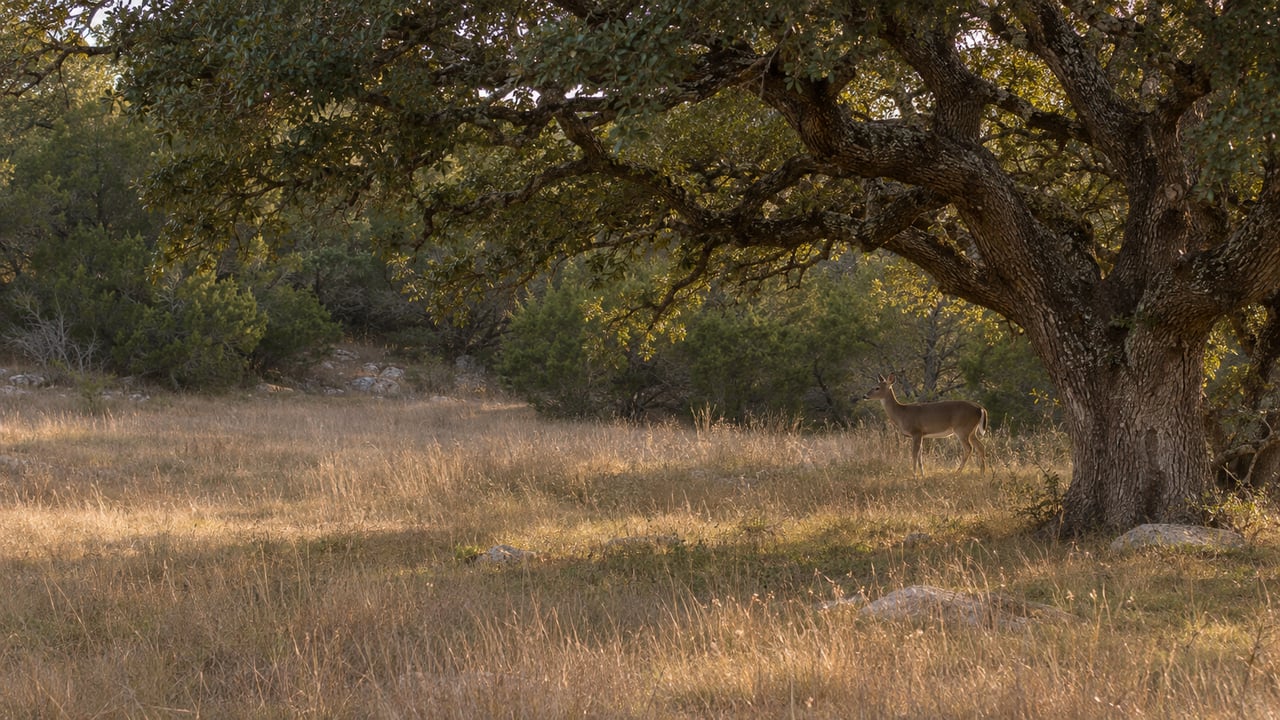
What a Deer Lease Pays on Hill Country Ranch Land This Season
November 19, 2026
Deer season in the Texas Hill Country is in its second week. In the North Zone, Texas Parks and Wildlife lists the general season as Nov. 7, 2026 through Jan. 3, 2027, so ranches in Burnet, Lampasas, Llano and San Saba counties have about six weeks of hunting left. Buyers walking a ranch between now and the new year will pass deer stands, and many of them will ask what a hunting lease would pay.
For most of this market the honest answer is a few dollars on every thousand. The lease is worth having, but the lease rate has stayed level while land prices kept climbing. A buyer paying today's Hill Country price is buying something the deer lease was never going to cover.
The Texas Chapter of the American Society of Farm Managers and Rural Appraisers publishes a land survey each spring. The 2025 Texas Rural Land Value Trends report covers transactions from calendar year 2025 and was presented in April 2026. It puts Lampasas, Llano, Mills and San Saba counties in a subregion it calls the Central Basin, along with McCulloch and Hamilton. For that subregion it reports rangeland hunting leases at $10 to $30 an acre, with activity marked "Moderate/Stable."
The same table prices the land under those leases. In 2025, open native pasture in the Central Basin ran $3,500 to $10,000 an acre, wooded native pasture $4,500 to $15,000, and live-water recreational property $6,000 to $20,000.
Put a lease rate over a land price and you get a gross annual yield before taxes, fencing, roads, water or feed. Across the Central Basin's ranges, that yield runs from about 0.07 percent, a $10 lease on $15,000 wooded land, to about 0.86 percent, a $30 lease on $3,500 open pasture. Those are the extreme ends of two ranges, and no real ranch has to sit at either one. Still, they mark the boundaries, and even the generous end stays below 1 percent.
A broader regional figure gives the same answer. The Texas Real Estate Research Center at Texas A&M reported in its second-quarter 2026 rural land report that the median price in Region 7, Austin-Waco-Hill Country, reached a record $8,040 an acre, up 8.63 percent year over year, with a typical tract of 199 acres. A 199-acre tract at that median costs roughly $1.6 million. Leased for hunting at $10 to $30 an acre, it brings in roughly $2,000 to $6,000 a year in gross income. At $30 an acre, gross lease income would take about 268 years to equal the purchase price. At $10 it would take about 800.
The appraisers' survey points to a different source of value. For the region west of Interstate 35, the report says demand for native rangeland "is dominated by recreational and aesthetic resources" and that agricultural production income "does not directly correlate to land values."
The gap is growing, and that matters more than any single year's number. ASFMRA's 2024 edition, which covers 2024 sales, reported the same $10 to $30 rangeland hunting lease range for the Central Basin, also marked "Moderate/Stable." The land bands moved in the meantime. The low end of open native pasture rose from $3,000 an acre in 2024 to $3,500 in 2025, and the low end of wooded native pasture rose from $4,000 to $4,500.
Mason County shows the same pattern. ASFMRA places it in a West Hill Country subregion with Menard and Kimble counties, where hunting leases ran $15 to $25 an acre in both the 2024 and 2025 editions. Native rangeland on 50 to 500 acres there rose from $3,000 to $10,000 an acre in 2024 to $4,000 to $10,000 in 2025. Tracts over 500 acres held at $2,500 to $7,000. Measured against those bands, Mason's lease range works out to roughly 0.15 to 1 percent gross.
The animals aren't the reason. Texas Parks and Wildlife's 2026 harvest forecast, released Oct. 1, estimates 1.973 million white-tailed deer in the Edwards Plateau and names the Llano-Mason area as the region's highest-density deer country. Hunting is plentiful in the counties where land values climbed. Lease rates are set by what hunters will pay for a season, and land prices are set by what a buyer from Austin or the Metroplex will pay to own the place outright. Those are different buyers working with different budgets, and the second group has been setting land prices.
The ASFMRA report is direct about who sets prices in the Central Basin. Recreational users "remain the primary drivers for land transactions," with buying pressure from both the Dallas-Fort Worth and Austin areas, and drive time from those cities "is consistently noted as a strong buyer consideration." The report says Central Basin buyers are "primarily looking for hunting tracts or scenic weekend retreats," and that live water draws a significant premium.
That combination explains the gap. A buyer looking for a hunting tract wants what a lease hunter wants, deer and cover. The buyer also wants a deed, a reasonable drive from home in Austin or the Metroplex, and a creek the grandchildren can stand in. Only the deer show up in the lease price. Everything else shows up in the per-acre price, and that's why a ranch with the same deer herd can sell for very different amounts depending on its distance from the interstate and whether it has running water.
TRERC reports the same pattern from the transaction side. In its second-quarter 2026 report, the center wrote that "demand for recreational and homesite properties in this region continues to drive market health" even at record prices. The center's October 2026 rural land column gives a slightly different Region 7 figure for the same second quarter, $8,028 an acre and up 8.3 percent year over year, and repeats the point about recreational and homesite demand. At either figure, a $30 lease returns well under half a percent of the land's price.
Burnet County sits in a different ASFMRA subregion grouped with the Austin area, where wooded native pasture ran from $5,500 to $35,000 an acre in 2025. That table lists a general rental range of $10 to $30 an acre and has no separate hunting line. On the Burnet County side of the Highland Lakes, land near the top of that range is priced almost entirely on proximity and views, and any rental income is small next to it.
None of this makes a lease worthless. On a $1.6 million ranch, $2,000 to $6,000 a year won't move the purchase decision, but it does cover part of the annual cost of owning the place. A lease that has run for several seasons also shows a buyer that the property has been hunted and that hunters have paid for the access.
Lease structure varies, and buyers touring this month should ask about it. In a Texas Farm Bureau article, Texas A&M AgriLife Extension specialist Tiffany Lashmet noted that Texas hunting leases can be priced per gun, per acre or as a flat fee. A per-acre figure from one ranch won't line up neatly with a per-gun figure from the next, so convert both to an annual dollar total before comparing them. Ask when the current lease ends, too, since many ranches go under contract during a season that runs into January.
Owners can take a pricing lesson from the same numbers. If buyers are paying for recreation and drive time, a listing should be priced on those terms. ASFMRA's report found that some Central Basin asking prices had come down, mostly on ranches that sat on the market "for a year or two with very high asking prices." It added that many of those were higher-quality ranches with live water, and the ones that did sell still brought a relatively high price. The report also notes that the drought that followed the July 2025 floods reduced recreational demand from buyers looking for live-water property.
Showing the lease history as income won't close the distance between a high asking price and a buyer's offer. A listing has a better chance when it presents the ranch the way the buyer will use it, with drive times to Austin and the Metroplex, the condition of the water, the stand locations, and the hunting history kept as part of the ranch record. Region 7 has also shifted toward smaller tracts, with TRERC reporting a typical size of 199 acres, down 4.32 percent from a year earlier. The buyer for a mid-size Hill Country tract is often someone who wants one place to hunt and spend weekends, not someone looking for rental income.
Per-acre prices also depend heavily on tract size, a point covered in the two markets behind the Hill Country land price. On acreage in Lampasas County, groundwater is another factor to weigh, as covered in Lampasas County's changing well rules.
This post is general market information and not legal, tax or financial advice. Confirm the details of any lease or purchase with the appropriate professional.
If you're touring a ranch this season or deciding how to present the hunting on yours, I'd be glad to go over the lease records, the water and the drive time with you and see how they fit current Hill Country pricing. Reach me through Shipley Ranches and let's connect before the season closes Jan. 3.
Stay up to date on the latest real estate trends.
Ready to buy or sell in the Texas Hill Country? Connect with Jim Banks for expert guidance, strategic marketing, and results-driven representation tailored to your ranch or luxury property.