Buying Development Land In Williamson County
May 28, 2026
May 28, 2026
Thinking about buying development land in Williamson County? A tract can look perfect on paper and still turn into a costly headache if you miss who regulates it, how access works, or whether utilities and drainage actually support your plans. If you want to buy with more confidence, it helps to know what to verify before you close. Let’s dive in.
In Williamson County, one of the first questions is not the size of the tract or even the price. It is who has authority over the land and what approvals your project may need. That answer can change depending on whether the property is inside city limits, in the unincorporated county, or in a city’s extraterritorial jurisdiction, also called the ETJ.
Under Texas law and Williamson County subdivision procedures, ETJ review can be handled by the city, the county, or both, depending on the agreement tied to that city. That matters because plats must have the correct approval signatures before they can be recorded. In some ETJ situations, municipal setback rules can also control when they conflict with county setbacks.
For you as a buyer, that means the entitlement path should be part of your early due diligence. Before you focus on layout ideas or pricing assumptions, confirm which local authority will review the tract and what that process looks like.
Outside city limits, Texas law generally requires a plat when land is divided into two or more parts for lots, streets, or other public-use areas. In Williamson County, subdivision approval depends on compliance with county regulations, and the county recording process requires proper approvals before anything is filed.
This is especially important because counties in Texas do not have general zoning authority in unincorporated areas. So if you are evaluating development land in Williamson County, the bigger issue is often not zoning in the usual sense. It is whether the tract can meet platting, access, drainage, and utility requirements.
That distinction catches many buyers off guard. A parcel may seem flexible because it is outside city zoning, but flexibility does not remove the need for county review, engineering, and recorded approvals.
A development tract needs more than road frontage on a map. You need to know whether legal and physical access can actually support the use you have in mind. In Williamson County, access questions should be tested early because driveway and road connection requirements can directly affect cost, layout, and timing.
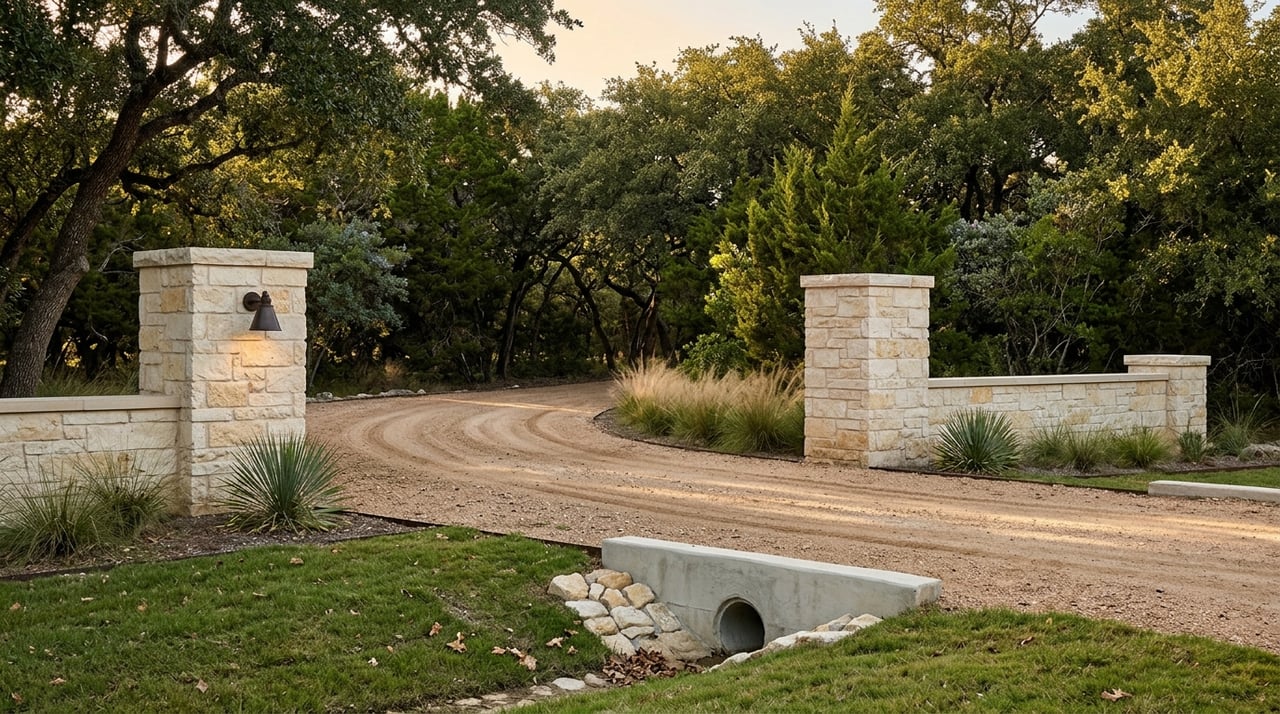
If your project will connect to a county-maintained road, Williamson County requires a driveway permit to build or modify that connection. The county notes that the owner applies, the county inspects the work, and the county may require culverts or ditch grading. A driveway is not considered authorized until construction is complete and inspection confirms it meets county standards.
Shared driveways also have limits. According to the county policy, shared driveways are limited to three residences and require a recorded shared access easement. If your plan depends on a longer private drive serving multiple lots, that is something to flag right away.
If the land fronts a state highway, county approval may not be enough. TxDOT requires a driveway permit for new or modified access driveways on the state highway system, and construction on the highway right-of-way should not begin until a fully executed permit is in place.
TxDOT also emphasizes coordination around driveway spacing, drainage impacts, access connections, and utility relocation. In practical terms, state highway frontage can be a major asset, but it can also come with a more detailed approval path than buyers expect.
In Williamson County, access planning is tied closely to engineering. County plat materials show that construction plans must identify water, sanitary sewer, and storm sewer utilities, along with easements for privately owned utilities.
Roadwork design is also reviewed by the County Engineer. That means internal circulation, road alignments, and service layout should not be treated as details to solve later. If you wait too long to test those items, you can end up redesigning the project after contract execution.
For many rural and edge-of-growth tracts, the utility picture is one of the biggest questions. It is not enough to hear that utilities are “nearby” or “available in the area.” You need to know what provider serves the tract, whether service is actually available, and what documentation will be required during the platting process.
Williamson County’s plat checklists require a letter of serviceability from the water provider unless the lots will use individual private wells. If the subdivision will rely on on-site sewage facilities, the county requires an OSSF subdivision review through the county program.
This is one reason development land should be evaluated as a system, not just as acreage. Water, wastewater, and the road network all shape what the tract can realistically support.
If public utilities are not available, private solutions may come into play. Williamson County states that the County Engineer’s office permits on-site sewage facilities, and owners must renew the OSSF license and maintenance contract at least every two years.
That does not automatically make a tract unsuitable. It does mean you should verify whether the land can support the intended number of systems and whether your subdivision concept aligns with county review requirements.
Drainage can change the economics of a development tract quickly. In Williamson County, all construction in the unincorporated county must comply with floodplain rules, and a Floodplain Development Permit is required if the property is within or adjacent to a 100-year floodplain.
The county also states that development in the floodway portion of that floodplain is prohibited except with extensive engineering analysis. If part of the site is affected, the impact may go far beyond the obvious wet areas shown during a casual visit.
Inside city limits, floodplain questions are handled by the city rather than the county. That is another reason jurisdiction should be confirmed at the beginning of your diligence period.
Williamson County adopted the Atlas 14 Floodplain Mapping Study on March 24, 2026, and the county says it will use that study as official rainfall data for drainage and floodplain management in unincorporated areas. For buyers, that means older plats, prior studies, or seller marketing packages may not reflect current county standards.
If the drainage story seems too simple, that is a sign to dig deeper. Updated mapping and current engineering review can reveal constraints that affect lot count, road placement, and site costs.
A tract may be technically developable and still not be the right opportunity. In unincorporated Williamson County, broad zoning does not usually guide compatibility the way it might in other markets. That means you need to evaluate the surrounding area through recorded documents and physical conditions rather than rely on a zoning label alone.
County plat checklists call for current deeds, existing plats, easements, and district-creation documents such as road, MUD, and PID records. Those records can help you understand how neighboring land is structured, what encumbrances may affect the site, and what infrastructure or district issues may influence future development.
This is where local land knowledge becomes especially valuable. The best opportunities are often the tracts where the surrounding access, utility framework, and recorded history support the vision you have in mind.
Williamson County’s own application materials show why early professional review matters. Plats require engineer and surveyor certifications, and county staff note that a submitted application is not automatically complete or accepted.
The county also encourages applicants to schedule time with the County Engineer or Floodplain Administrator in advance. That is a strong signal that it is usually better to uncover challenges before closing rather than try to solve them after you own the land.
A thoughtful land-buying process often includes reviewing:
When those pieces line up early, you are in a much stronger position to evaluate value and risk.
In Williamson County, the best development land is usually not just the prettiest tract or the one with the most frontage. It is the tract where jurisdiction, access, utilities, and drainage work together in a way that supports your intended use.
That is why strong due diligence matters so much in this market. A buyer who confirms the governing authority, checks permit paths, verifies utility serviceability, reviews floodplain status, and studies recorded documents is already making a more informed decision.
If you are considering development land in Williamson County or the surrounding Central Texas market, working with someone who understands how land behaves on the ground can save you time, money, and frustration. When you are ready to talk through a tract, connect with Shipley Ranches.
Stay up to date on the latest real estate trends.




Ready to buy or sell in the Texas Hill Country? Connect with Jim Banks for expert guidance, strategic marketing, and results-driven representation tailored to your ranch or luxury property.